
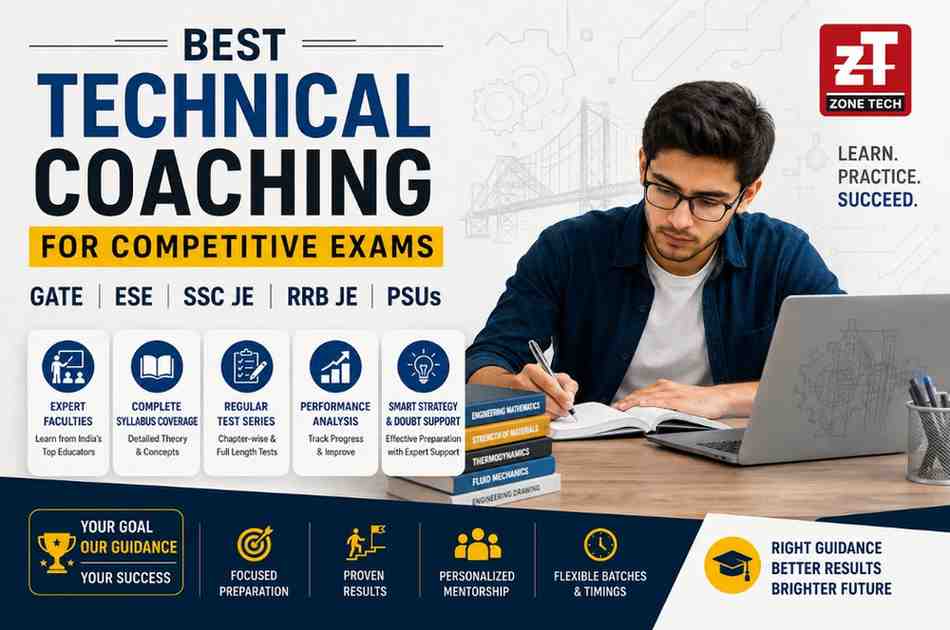
Competitive technical examinations require much more than simply memorising formulas, reading textbooks, or completing a large number of practice questions. Students preparing for technical competitive exams need a combination of conceptual understanding, structured preparation, problem-solving ability, time management, regular practice, and the confidence to apply their knowledge under examination conditions. With a large syllabus and strong competition, many students find it difficult to decide how to organise their preparation effectively. This is where professional guidance can make a meaningful difference. Choosing the Best Technical Coaching can provide students with a structured learning environment where complex technical concepts are explained systematically and preparation is aligned with the requirements of competitive examinations.
The right coaching programme should not be judged only by advertisements, infrastructure, or claims about results. Students should look at the quality of teaching, subject expertise, study material, practice methodology, doubt-solving support, mock tests, course structure, and the overall learning environment. A good Technical Coaching programme should help students understand the fundamentals before moving towards advanced questions and examination-level problem solving. At Zonetech, the focus can be placed on creating a learning experience that combines technical knowledge with structured preparation, allowing students to develop both conceptual clarity and examination confidence. Whether a student is beginning preparation or looking to strengthen an existing study plan, selecting the right coaching environment can make the preparation journey more organised and productive.
Technical coaching refers to structured educational guidance designed to help students develop knowledge and problem-solving skills in technical subjects. Depending on the programme and examination, technical coaching may cover areas such as engineering concepts, mathematics, reasoning, technical aptitude, core subjects, numerical problem solving, and other examination-specific topics.
Unlike casual self-study, coaching generally follows a defined curriculum and timetable. Students are guided through topics in a planned sequence, allowing them to build their understanding gradually. This can be particularly useful when the examination syllabus is extensive or when students are preparing for highly competitive technical examinations.
Professional coaching can also introduce students to different question patterns and examination strategies. The objective should not simply be to complete the syllabus but to understand how concepts are applied in competitive examinations.
Competitive examinations are designed to test how effectively candidates can apply knowledge under time constraints. Two students may understand the same concept, but the student who can identify the correct approach quickly and avoid unnecessary calculation may perform better.
This is why preparation needs to include both learning and application.
A structured Technical Coaching Classes programme can help students move through these stages systematically. Concepts can be introduced, explained, practised, reviewed, and tested through different types of questions. Over time, students can identify the topics they understand well and the areas that require additional attention.
The value of coaching therefore comes not simply from attending classes but from having a structured system that supports continuous improvement.
There is no single coaching institute that is automatically the best choice for every student. The right institute depends on the student's examination, current academic level, learning style, schedule, and career goals.
However, certain factors can help students make a more informed decision.
The first is the quality and experience of the faculty. Technical subjects often require detailed explanations, and students should be able to understand not only what the answer is but why a particular method works. Experienced educators can often simplify difficult concepts and connect theoretical knowledge with practical problem solving.
The second consideration is the curriculum. A well-structured curriculum should cover the relevant syllabus in an organised manner without rushing through important concepts. It should also leave sufficient time for revision and examination-oriented practice.
The third factor is the quality of study material and testing support. Students need opportunities to practise different types of questions and evaluate their progress regularly.
Teachers play one of the most important roles in technical exam preparation.
A strong teacher does more than explain a textbook chapter. They can identify common mistakes, introduce efficient problem-solving methods, explain difficult concepts from multiple perspectives, and guide students toward better preparation habits.
For technical subjects, conceptual clarity is particularly important because many advanced questions are based on fundamental principles.
An experienced faculty member can help students understand these relationships rather than encouraging them to rely entirely on memorisation.
Students should therefore research the teaching team before joining a Best Technical Coaching Institute. Information about faculty qualifications, subject expertise, teaching experience, and student support can provide useful context.
Competitive exam preparation becomes easier to manage when the syllabus is divided into logical sections.
A structured curriculum can help students understand what they need to study, when they need to study it, and how each topic connects with the next.
For example, foundational concepts may need to be completed before students move into advanced applications. Similarly, difficult subjects may require additional practice time.
A good curriculum should also include revision.
Completing the syllabus once does not guarantee retention. Students need repeated exposure to important concepts and questions.
This is why effective coaching should balance new learning with revision, practice, and testing.
One of the biggest challenges in technical examinations is the temptation to memorise shortcuts without understanding the underlying concepts.
Short methods can certainly be useful, but they should support conceptual understanding rather than replace it.
When students understand why a formula works or how a technical principle applies, they are better prepared to deal with unfamiliar questions.
This is especially important in competitive examinations where questions may be presented differently from classroom examples.
A strong Technical Coaching programme should therefore encourage students to ask questions and understand the logic behind problem-solving methods.
Technical subjects require practice.
Students may understand a concept during a lecture but struggle to solve questions independently. Regular practice helps bridge this gap.
Practice should include basic questions, intermediate problems, advanced questions, previous examination-style questions, and mixed-topic exercises.
Over time, students can become more comfortable identifying which concept is required for a particular problem.
The goal is not simply to solve a large number of questions. The quality of practice matters as well.
Students should review incorrect answers and understand why they made the mistake.
Mock tests are an important component of competitive exam preparation because they provide students with an opportunity to practise under realistic conditions.
A well-designed mock test can help students evaluate their speed, accuracy, time allocation, and understanding of different topics.
However, taking a test alone is not enough.
Performance analysis is equally important.
Students should identify which questions they got wrong, which questions took too much time, and which topics repeatedly create difficulties.
A coaching institute that provides meaningful feedback after tests can help students turn mistakes into learning opportunities.
Technical subjects often involve concepts that cannot always be understood during a single classroom explanation.
Students may encounter difficulties while solving practice questions independently.
Accessible doubt-solving support can therefore make a significant difference.
Students should feel comfortable asking questions without worrying that they are falling behind the class.
Whether doubt support is provided through classroom discussions, dedicated sessions, online interaction, or other academic methods, the important factor is that students receive meaningful explanations.
Quality study material can make preparation more organised.
Students should have access to relevant notes, practice questions, revision resources, previous examination-style material, and other resources appropriate to their course.
However, more material does not automatically mean better preparation.
Too many books, PDFs, question banks, and online resources can actually create confusion.
A good coaching programme should help students understand which resources are important and how they should be used.
Time management is an essential part of examination preparation.
Students often know the material but lose marks because they spend too much time on difficult questions.
Coaching can help students practise solving problems within realistic time limits.
As students complete mock tests and timed exercises, they can gradually understand how much time they should spend on different types of questions.
The objective is not necessarily to solve every question immediately. It is to make sensible decisions about which questions to attempt first and which ones to leave for later.
Revision should be part of the preparation plan from the beginning.
Waiting until the final weeks to revise the entire syllabus can create unnecessary pressure.
Students should periodically revisit important concepts, formulas, technical principles, and commonly repeated question types.
Short revision cycles can help reinforce learning while reducing the amount of information that must be reviewed at once.
A structured Technical Coaching Classes programme can incorporate revision into the course rather than treating it as something students must manage independently.
Students do not all learn at the same pace.
Some may understand technical concepts quickly but need additional practice with numerical questions. Others may need more time to develop their fundamentals before attempting advanced problems.
A supportive coaching environment should recognise these differences.
Personalised guidance can help students understand where they need to improve and how they can modify their study approach.
This does not necessarily mean one-to-one teaching for every student. Regular feedback, doubt support, performance analysis, and teacher interaction can also contribute to a more personalised learning experience.
Technology has changed the way students prepare for competitive examinations.
Digital learning platforms can provide recorded lessons, online tests, study resources, performance reports, and other learning tools.
These resources can be particularly useful for revision because students can revisit difficult topics when necessary.
However, technology should support learning rather than replace effective teaching.
The most useful combination may involve classroom or live instruction alongside digital resources that allow students to practise and revise independently.
Students now have more options than ever when selecting coaching.
Offline classes can provide direct interaction with teachers and classmates. Some students find this environment useful for maintaining discipline and a regular study schedule.
Online coaching offers greater flexibility and can be useful for students who live far from coaching centres or prefer learning from home.
Neither approach is universally better.
Students should consider their learning style, schedule, internet access, self-discipline, preferred interaction level, and examination timeline before making a decision.
The learning environment can influence motivation and consistency.
A good coaching environment should encourage questions, regular practice, discipline, and constructive competition.
Students should feel that they can make mistakes and learn from them.
Competitive preparation can be stressful, so academic support and realistic guidance are valuable.
An environment that focuses only on rankings and pressure may not be suitable for every learner.
Students sometimes choose coaching based solely on promotional claims, fee discounts, large classroom numbers, or impressive advertisements.
These factors do not necessarily indicate educational quality.
Another common mistake is expecting coaching to do all the work.
Even the Best Technical Coaching cannot replace individual practice, revision, and consistent effort.
Students should treat coaching as a structured support system rather than a substitute for personal preparation.
Another mistake is using too many resources simultaneously. Students often switch between multiple teachers, books, online courses, and question banks. This can make preparation fragmented.
A focused study plan is usually easier to maintain.
At Zonetech, technical learning can be approached through structured academic guidance, conceptual understanding, practice, and examination-oriented preparation. The objective of a professional coaching environment should be to help students understand technical concepts clearly while developing the problem-solving skills required to apply those concepts in competitive examinations.
Students considering a coaching programme should review the specific course structure, faculty information, learning resources, schedule, testing methodology, and support available for their particular examination. This allows them to determine whether the programme matches their individual requirements.
The right coaching relationship should be based on learning quality rather than promotional claims.
Joining a coaching programme is only the beginning.
Students should attend classes consistently, maintain organised notes, practise questions regularly, revise completed topics, analyse mock-test performance, and ask questions when concepts are unclear.
It is also useful to maintain a record of recurring mistakes.
For example, if a student repeatedly makes errors in a particular technical topic, that area should become a priority for additional revision.
Over time, this approach can make preparation more targeted and efficient.
A practical preparation cycle can involve learning, practising, testing, analysing, and revising.
First, understand the concept.
Then solve basic questions to establish familiarity.
Move towards more challenging problems.
Take timed tests to evaluate performance.
Analyse mistakes.
Finally, revise the weak areas and repeat the process.
This cycle can gradually improve both knowledge and examination readiness.
What is the Best Technical Coaching for competitive exams?
The best coaching depends on the student's examination, learning requirements, academic level, and goals. A strong programme generally offers experienced faculty, structured syllabus coverage, quality study material, practice tests, doubt support, revision, and performance analysis.
Why should students join Technical Coaching?
Technical coaching can provide structured preparation, expert guidance, regular practice, examination-oriented testing, and academic support. It can be particularly useful for students who find it difficult to organise a large technical syllabus independently.
What should I check before choosing a Technical Coaching Institute?
Check faculty expertise, course curriculum, study resources, mock-test system, doubt support, class format, student feedback where available, schedule, fees, and whether the course specifically matches your target examination.
Are Technical Coaching Classes better than self-study?
It depends on the student. Self-study can work well for disciplined learners with strong fundamentals, while coaching can provide structure and expert guidance. Many students benefit from combining professional coaching with consistent independent practice.
How important are mock tests for technical competitive exams?
Mock tests can help students practise time management, assess accuracy, identify weak areas, and become familiar with examination-style pressure. Reviewing mistakes after each test is an important part of getting value from mock examinations.
Preparing for a competitive technical examination requires consistency, conceptual understanding, practice, and the ability to apply knowledge under time constraints. Choosing the right coaching programme can provide valuable structure and guidance throughout this process. However, the Best Technical Coaching is not simply the institute with the biggest advertisement or the most impressive promotional claims. It is the programme that provides relevant academic support, experienced teaching, organised course content, quality practice, useful testing, and an environment where students can steadily improve.
When evaluating a Best Technical Coaching Institute, students should carefully consider faculty expertise, syllabus coverage, study material, doubt-solving support, mock tests, performance analysis, learning format, and personal attention. These factors can help students determine whether a coaching programme genuinely fits their preparation requirements.
Technical Coaching Classes can provide a structured foundation, but students must also take responsibility for their own preparation. Regular revision, independent practice, error analysis, and disciplined time management remain essential. Coaching should guide the student, while consistent effort turns that guidance into progress.
For students looking for structured preparation and technical learning support, Zonetech can be considered as part of their search. Prospective students should review the specific programme, curriculum, faculty, schedule, resources, and examination requirements before enrolling.
Ultimately, competitive exam preparation is a long-term process rather than a quick shortcut. With the right combination of expert guidance, focused study, regular practice, realistic testing, and personal commitment, students can approach their technical examinations with greater clarity and preparedness. The goal of a good coaching programme should be to help learners develop the knowledge, confidence, and problem-solving ability they need to perform at their best.
Leave a Reply
Your email address will not be published. Required fields are marked *