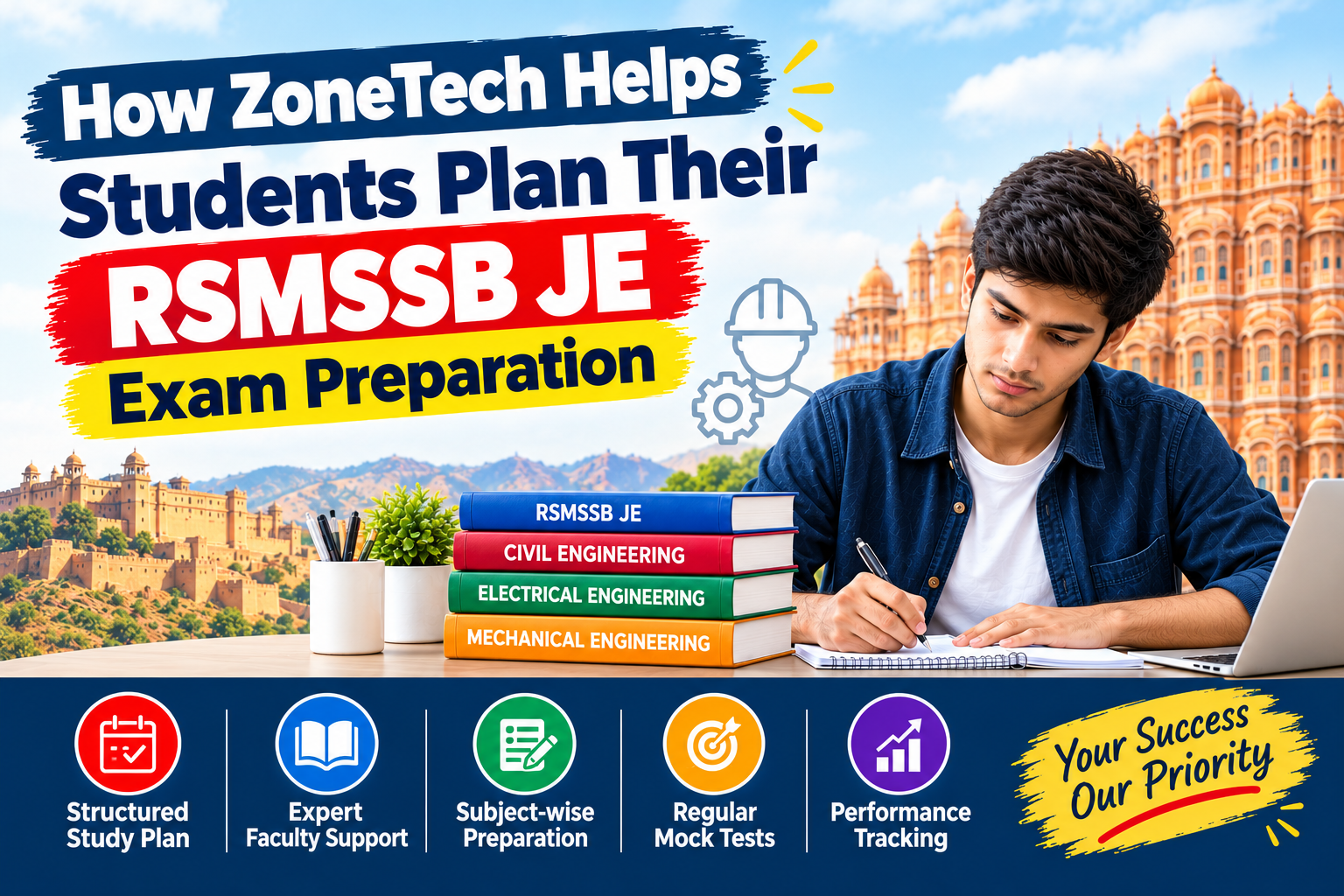
Preparing for the Rajasthan Subordinate and Ministerial Services Selection Board Junior Engineer examination requires a structured study plan, consistent revision, and a clear understanding of technical and non-technical subjects. For engineering diploma holders and graduates, the challenge is not simply covering the syllabus but also managing time, practising questions, strengthening fundamental concepts, and preparing according to the relevant examination pattern. Without a well-organised strategy, students may spend too much time on familiar topics while neglecting important areas that need additional practice. A planned approach helps aspirants divide their preparation into manageable stages, monitor their progress, and develop the confidence needed to attempt the examination effectively.
ZoneTech aims to support students in organising their preparation journey through structured learning options and course-based study planning. Whether students are exploring the Zone Tech RSSB JE preparation programme, comparing an RSMSSB JE Course, or considering an RSMSSB Online Course or RSMSSB Offline Batch, choosing an approach that matches their learning needs is an important first step. A useful preparation plan should combine technical subject learning, Rajasthan General Knowledge where applicable, regular revision, previous-year question practice, and mock tests based on the relevant exam pattern. This guide explains how students can plan their RSMSSB JE preparation more effectively and what they should consider when selecting a course with ZoneTech.
Before creating a study timetable, students should understand the examination for which they are preparing. The Rajasthan Junior Engineer recruitment examination is intended for eligible candidates applying to relevant engineering posts, with the applicable discipline and eligibility requirements depending on the recruitment notification. Civil, Electrical, and Mechanical Engineering aspirants may need to focus on different technical subjects, while other components of the examination depend on the official syllabus and current recruitment rules.
The first step is to review the latest official notification, syllabus, examination pattern, eligibility requirements, and selection process for the specific recruitment cycle. Students should not rely only on older study material because subjects, marks distribution, recruitment conditions, and examination arrangements can change. Understanding these details provides a foundation for creating a realistic study plan and identifying which subjects require the most attention.
For students considering an RSMSSB JE Course, the syllabus should be the starting point for evaluating the available learning options. A useful course should help students organise their preparation, understand technical concepts, practise relevant questions, and revise systematically. Before enrolling in any programme, candidates should confirm that the course content matches their engineering discipline and the relevant examination requirements.
A structured preparation plan helps students use their study time more effectively. Many aspirants balance exam preparation with college, employment, family responsibilities, or other competitive examinations. Without a timetable, it can be difficult to decide what to study each day, how often to revise completed topics, and when to begin full-length practice tests. A clear schedule reduces uncertainty and helps students work towards measurable study goals.
An effective plan usually includes four connected activities: learning concepts, solving practice questions, revising previously studied material, and evaluating performance. Concept learning develops subject understanding, while question practice helps students apply that knowledge. Revision improves recall, and tests help identify areas that require further attention. These activities should be balanced instead of leaving all revision and testing until the final weeks.
ZoneTech can be considered as part of this planning process by students who prefer a more organised approach to exam preparation. When reviewing a course, check how its teaching schedule, study materials, practice sessions, and revision support fit your needs. The objective is not simply to attend classes or complete recorded lessons; it is to understand the syllabus and build the ability to solve questions independently.
A realistic timetable is one of the most useful tools for RSMSSB JE preparation. Begin by listing the subjects included in the latest official syllabus for your engineering discipline. Divide each subject into smaller topics and estimate how much time you may need to understand and practise them. Students who find certain technical subjects difficult should allocate more time to those areas rather than distributing study hours equally across every topic.
For example, a student preparing alongside college or a job may be able to study for a few focused hours each day, while a full-time aspirant may have more flexibility. The timetable should reflect the time actually available, not an unrealistic target that becomes difficult to maintain. Reserve separate periods for learning new topics, solving questions, reviewing mistakes, and revising completed chapters.
A weekly review can help you determine whether the timetable is working. If you repeatedly fail to complete a particular subject, adjust the schedule instead of abandoning it. Likewise, if a topic takes less time than expected, use the extra time for revision or practice. Students exploring an RSMSSB Online Course should consider whether the lesson schedule allows them to follow a consistent routine while managing their other responsibilities.
Technical subject preparation is an important part of engineering recruitment examinations. However, the topics and their relevance depend on the discipline and the official syllabus for the particular recruitment. Civil Engineering candidates may need to revise areas such as building materials, surveying, structural concepts, and other prescribed civil engineering subjects. Electrical Engineering candidates may need to study relevant electrical circuits, machines, measurements, and power-related concepts. Mechanical Engineering candidates should focus on the technical subjects specified for their examination.
Instead of attempting to memorise every formula without understanding it, students should first strengthen the fundamentals. Learn the concept, understand the conditions under which a formula applies, and solve basic examples before moving to more complex questions. Maintaining a formula notebook can make revision easier, especially for topics involving calculations. Include short explanations, units, important assumptions, and common mistakes alongside the formulas.
Practice should follow each topic as soon as possible. Solving questions immediately after learning a concept helps reveal gaps in understanding while the material is still fresh. If you repeatedly make the same mistake, revisit the underlying concept before attempting more questions. When evaluating the Zone Tech RSSB JE preparation option, students should check the technical subjects covered and ensure that the programme aligns with their particular engineering branch.
Technical knowledge alone may not cover every component of an examination. Depending on the current recruitment notification, candidates may also need to prepare Rajasthan General Knowledge or other non-technical subjects. These areas should be included in the study timetable from the beginning rather than postponed until technical preparation is complete.
For Rajasthan-related topics, students can organise their study into manageable categories based on the official syllabus. Depending on the prescribed content, these may include Rajasthan's history, geography, culture, heritage, and other relevant general knowledge areas. Use reliable and up-to-date study resources, and revise facts regularly because information-based subjects can be difficult to retain when studied only once.
Short revision notes, topic-wise questions, and regular self-tests can help students identify information they have forgotten. Rather than reading large amounts of material repeatedly without checking recall, close the book and attempt to summarise the key facts from memory. Then review the material to identify gaps. The exact weight and content of non-technical subjects should always be checked against the current official examination pattern.
The right learning format depends on a student's routine, preferred teaching style, access to learning facilities, and need for interaction. An RSMSSB Online Course may suit students who want to study from home, manage a flexible timetable, or revisit lessons when the programme provides recorded access. Online learning can also be convenient for students who live far from a suitable coaching centre. However, it requires self-discipline, reliable access to the learning platform, and a consistent schedule for completing lessons and practice work.
An RSMSSB Offline Batch may be more suitable for students who prefer face-to-face teaching, a fixed class timetable, and an environment dedicated to studying. In-person classes can make it easier to ask questions directly and follow a regular routine. The practical value of an offline programme depends on factors such as class size, teacher accessibility, travel time, batch timing, and the quality of the course material.
Neither format is automatically better for every student. Before choosing a programme at ZoneTech, review the actual delivery format, available support, course schedule, and learning resources. Ask whether the course includes practice sessions, doubt clarification, revision support, and tests. Choose the format that you can follow consistently over the preparation period rather than selecting it solely because it is popular.
Previous-year question papers can help students understand how concepts are tested and what kinds of questions may appear in an examination. They are also useful for identifying topics that need more practice. However, students should use previous papers as a learning resource rather than assuming that the next examination will repeat the same questions or follow an unchanged pattern.
Begin by solving questions topic by topic while learning the syllabus. This allows you to check your understanding without the pressure of completing an entire paper under timed conditions. Once you have covered a reasonable portion of the syllabus, attempt full papers according to the relevant examination format. Set a timer, avoid unnecessary interruptions, and record your score and mistakes.
After completing a paper, analyse every incorrect or unanswered question. Determine whether the problem arose from a conceptual gap, a calculation error, forgotten information, or poor time management. This analysis is often more valuable than simply counting the number of correct answers. Students using an RSMSSB JE Course should look for opportunities to incorporate previous-year question practice into their regular study routine.
Mock tests provide an opportunity to practise under examination-like conditions and evaluate preparation progress. They can help students become familiar with timed problem-solving, identify weaker subjects, and improve their approach to selecting questions. However, the test format should match the latest official examination pattern as closely as possible, and students should check whether the test material reflects the current syllabus.
A useful mock-test routine includes three stages. First, attempt the test under the specified time limit. Second, review the answers and identify patterns in your mistakes. Third, revise the relevant concepts and solve additional questions from the areas that caused difficulty. This cycle turns each test into a learning opportunity rather than a one-time assessment.
Students should avoid judging their entire preparation based on a single mock-test score. Performance can vary depending on the difficulty of the paper, the subjects covered, and the student's familiarity with the questions. Look for trends across several tests. If accuracy improves but completion time remains high, practise solving questions more efficiently. If time management is good but accuracy is low, focus on conceptual clarity and careful reading.
When comparing ZoneTech's available learning options, confirm which types of tests and performance-review facilities are actually included in the selected course. Regular practice is most useful when students take the time to understand their results and act on the feedback.
Revision should be a continuous part of RSMSSB JE preparation. Students who study a topic once and do not return to it may struggle to recall the information after several weeks. A planned revision routine helps keep previously learned material accessible while new topics are being covered.
One practical approach is to review a topic shortly after learning it, revisit it again after a few days, and schedule further reviews according to how well you remember it. The exact intervals can be adjusted to suit your timetable. Technical subjects may require repeated numerical practice, while fact-based subjects may benefit from short notes, flashcards, and self-testing.
Keep your revision resources organised. A concise notebook containing formulas, definitions, common mistakes, and important concepts can be easier to review than repeatedly reading entire textbooks. For Rajasthan GK and other information-based subjects, create topic-wise notes that can be checked quickly. Avoid copying too much information; focus on material that helps you remember and apply the concepts.
As the examination approaches, allocate time to both revision and practice tests. Do not stop solving questions entirely in order to read notes continuously. A balance between recall, application, and timed practice can help you identify weaknesses before the examination date.
One of the biggest challenges for aspirants is maintaining consistency over several weeks or months. Students may begin with an intensive timetable but find it difficult to sustain. A more practical approach is to set clear daily goals, track completed topics, and build regular breaks into the schedule. Consistency is usually more useful than repeatedly following an unrealistic routine for a few days.
Another common mistake is collecting too many books, notes, videos, and online resources. Constantly switching between materials can make it harder to complete the syllabus systematically. Choose reliable resources that match the official syllabus and use additional material only when it addresses a specific learning gap. Likewise, avoid postponing mock tests until the final stage of preparation. Early practice helps you identify weaknesses while there is still time to improve them.
Students should also avoid ignoring difficult topics. If a chapter feels challenging, break it into smaller sections, revise the fundamentals, and solve simpler questions before progressing. Ask for clarification when needed and revisit the topic after additional practice. A structured RSMSSB JE preparation plan should be flexible enough to address weaknesses without losing sight of the overall syllabus.
Selecting a coaching programme is an important decision, but students should evaluate it according to their learning needs rather than relying on promotional claims alone. ZoneTech can be explored by aspirants looking for a more organised approach to RSSB JE exam preparation. Before enrolling, review the current programme details and check whether the course covers your engineering discipline, follows the relevant syllabus, and offers a learning format that fits your routine.
When considering the Zone Tech RSSB JE option, make a list of the support you need. You may be looking for structured technical classes, an organised study schedule, question practice, revision resources, or a learning environment that helps you remain consistent. Compare these requirements with the features that ZoneTech actually provides. Confirm the availability of online or offline learning, the class timetable, course duration, study material, and any additional support before making a decision.
Students should also consider their own responsibility in the preparation process. Attending classes or watching lessons is only one part of learning. You need to revise the material, solve questions, track your mistakes, and practise under timed conditions. A course can help organise these activities, but progress depends on how consistently you apply what you learn.
By combining a suitable learning format with a realistic timetable and regular performance reviews, aspirants can develop a more focused approach to the RSMSSB JE examination. The goal is to build subject understanding, improve problem-solving skills, and prepare according to the applicable examination requirements.
As the examination approaches, shift your attention towards consolidating what you have learned. Review the official syllabus and check which topics remain incomplete. Prioritise essential concepts and recurring weaknesses, but avoid spending all your time on a single difficult chapter at the expense of other important subjects.
Use mock tests and previous-year papers to practise time management, then review the mistakes carefully. Revise formulas, key definitions, and important factual information using concise notes. Make sure you understand the examination instructions, reporting requirements, permitted items, and other practical details provided in the official notification or admit card.
The final stage should focus on strengthening existing preparation rather than attempting to learn every topic from the beginning. Maintain a realistic study schedule and allow enough time for rest. Arriving at the examination with a clear understanding of the process and a structured revision routine can help you approach the paper more calmly.
Planning for the RSMSSB JE examination requires a balanced approach that combines syllabus analysis, technical subject preparation, relevant non-technical study, question practice, mock tests, and regular revision. Students should begin by reviewing the latest official notification and then create a timetable that matches their engineering discipline, current preparation level, and available study hours. Tracking progress and analysing mistakes can help them adjust the plan and focus on areas that need improvement.
ZoneTech can be considered by students exploring an RSMSSB JE Course, RSMSSB Online Course, or RSMSSB Offline Batch. Before choosing a programme, verify the current course features, syllabus coverage, schedule, and available learning support. The most suitable preparation approach is one that fits your needs and encourages consistent learning. With a realistic timetable, reliable study resources, and regular practice, aspirants can make their preparation more organised and work steadily towards their Junior Engineer examination goals.
1. How should I start preparing for the RSMSSB JE examination?
Begin by reviewing the latest official notification, eligibility requirements, syllabus, and examination pattern. Divide the syllabus into smaller topics, create a realistic timetable, and combine concept learning with question practice and regular revision.
2. Which is better: an RSMSSB Online Course or an RSMSSB Offline Batch?
The choice depends on your learning preferences, schedule, location, and need for interaction. Online courses may offer greater flexibility, while offline batches provide scheduled classroom learning. Compare the actual course features and choose the format you can follow consistently.
3. Why are mock tests important for RSMSSB JE preparation?
Mock tests help you practise under timed conditions, evaluate your understanding, and identify topics that need more attention. Reviewing mistakes after each test is essential for turning practice into measurable learning.
4. How can I prepare for technical subjects in the RSMSSB JE exam?
Follow the syllabus for your engineering discipline, strengthen fundamental concepts, practise topic-wise questions, and revise formulas regularly. Use previous-year papers and mock tests to assess your progress and identify weaknesses.
5. Should I prepare Rajasthan GK alongside technical subjects?
If Rajasthan GK or other non-technical subjects are included in the applicable official syllabus, prepare them alongside technical subjects. Regular short study sessions and revision can help you cover these areas without delaying technical preparation.
6. How can ZoneTech help me plan my RSMSSB JE preparation?
Explore ZoneTech's current course details to see whether its teaching format, syllabus coverage, schedule, and available learning support match your requirements. Combine any course you choose with independent revision, question practice, and performance tracking.
7. How can I stay consistent during RSMSSB JE preparation?
Set achievable daily goals, follow a weekly timetable, revise previously studied topics, and track completed work. Adjust the schedule when necessary and use practice-test results to decide which subjects need more attention.
Access live classes, recorded lectures, quizzes and test series from your mobile.



Leave a Reply
Your email address will not be published. Required fields are marked *